
3 February 2026
The TOLIFE project has successfully navigated its second major phase, marking a period of intense technical development and clinical monitoring. From March 2024 through August 2025, the consortium progressed from its initial practical frameworks into the real-world application of its tools, bringing the vision of a personalized health solution for patients with Chronic Obstructive Pulmonary Disease (COPD) closer to reality. This shift marks the transition from preliminary testing toward an extensive pilot deployment, essential for optimizing the system ahead of future clinical assessments.
The Analytics Suite: transforming daily physiological signals into trustworthy clinical intelligence
A central objective during the period was the refinement of the analytics tools: the consortium transitioned from early-stage prototyping to a fully automated infrastructure capable of managing complex data in real-time.
A substantial leap forward was the development of an automated system (Robotic Process Automation – RPA) that collects data daily from home-based sensors and transforms them into a clean, organized formats. These files are stored in a central digital library that all partners can access (Network Attached Storage – NAS). This guarantees that every analysis is performed on clean, ready-to-use data, ensuring results are both reliable and traceable.
The AI models have been trained to decode physiological signals across four key domains, enabling precise patient characterization and the assessment of health outcomes through non-intrusive, everyday devices:
- Mobility: thanks to smart shoes, smartphones, and smartwatches, the algorithms can precisely calculate walking speed and stride length, vital indicators of functional capacity. A recent study has validated this adaptive AI framework, proving it can accurately estimate gait speed in daily life, regardless of the device combination worn, showing a strong correlation to the clinical six-minute walk distance (6MWD) standard(https://ieeexplore.ieee.org/document/11316495).
- Sleep quality: a smart mattress cover allows for the monitoring of sleep duration, respiratory rate, heart rate, and nighttime movements, ensuring the immediate detection of any anomalies.
- Heart health: advanced algorithms have been developed to refine cardiac signals extracted from smartphones, utilizing denoising techniques to remove motion artifacts and provide a precise heart rate reading.
- Lung Function: the SpiroApp records daily breathing data and categorizes them as missing, unreliable, or acceptable through rigorous quality checks; this validated data stream allows the analytics models to predict trends in lung capacity over time.
To make these insights immediately understandable for clinicians, “traffic light” risk system (green, yellow, and red) was implemented. This phase incorporates logic based on clinical rules, where alerts are automatically triggered by walking speed or sleep efficiency drops below critical thresholds. By merging Artificial Intelligence with clinical experience, this hybrid approach ensures that alerts are consistently based on solid medical evidence.
However, it is recognized that for clinicians, receiving an alert is insufficient; it is essential to understand why the AI signaled a risk. Work is therefore progressing on “Explainable AI” (XAI): the goal is to clearly illustrate which factors (for instance, a decrease in mobility combined with worsening sleep) pushed the system toward a red alert.

Smart Sensing: bridging clinical accuracy and daily life through reliable technology
In parallel, the smart sensing department finalized the technical validation of the physical monitoring kit. This process involved the functional testing of the TOLIFE smart sensors to assess their performance compared to reference instruments, ensuring they were accurate, affordable, and user-friendly for patients’ daily lives.
This integrated hardware suite includes:
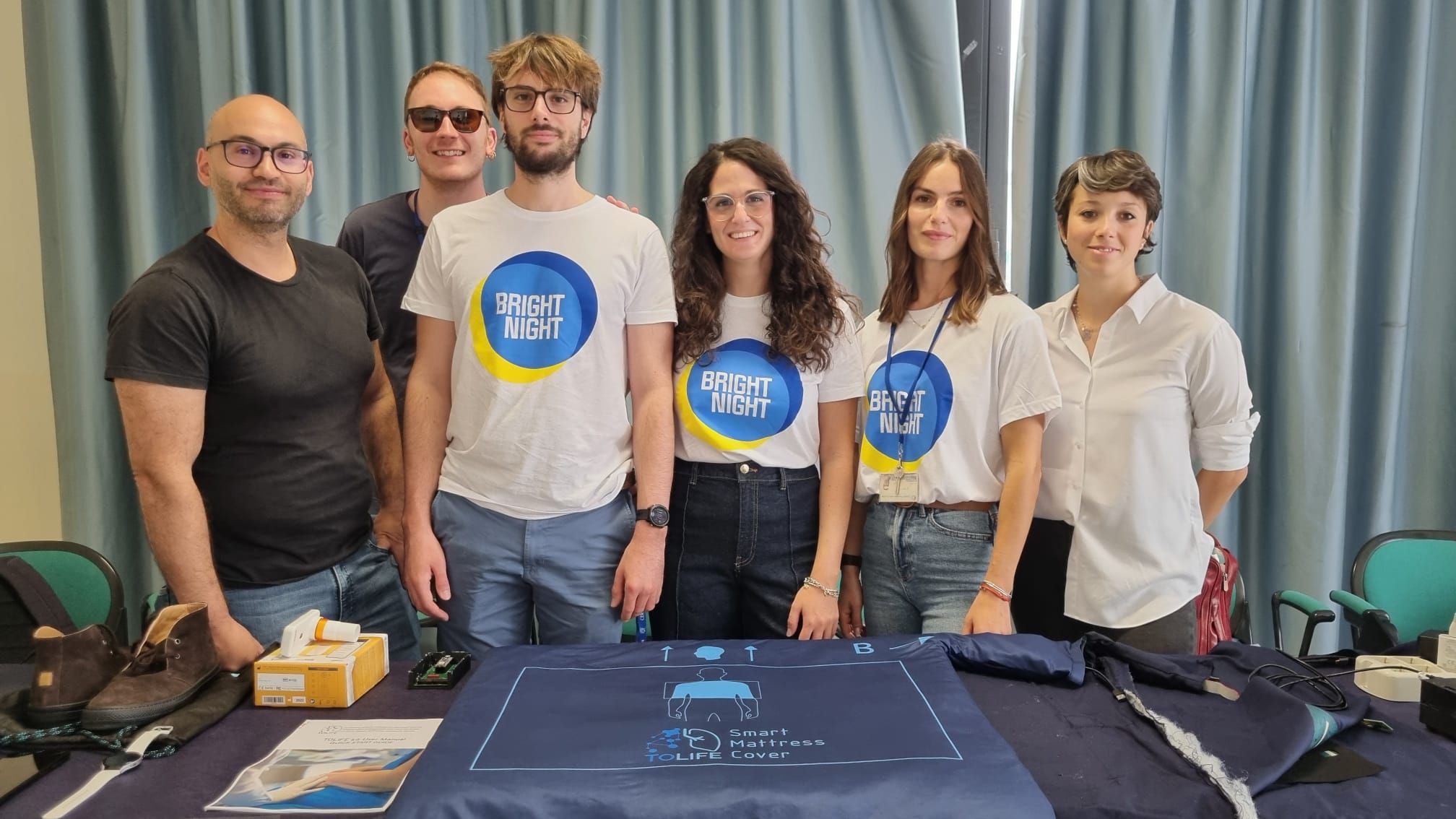
- a smart mattress cover, equipped with sensors that track heart and breathing rates during sleep, as well as its quality;
- smart shoes, that analyze walking patterns and posture, providing vital data on daily mobility and physical activity;
- a smartwatch and smartphone, that working in tandem, monitor heart rate and heart rate variability, while acting as the core engine that drives the system’s data flow;
- a mini-spirometer, a portable device that, combined with a custom-developed app, allows patients to easily measure their lung function and blood oxygen levels from the comfort of home.
The latest field results confirm that the TOLIFE kit is an exceptionally powerful and reliable tool, maintaining a high level of stability with an average data loss rate of only 2%. This consistent performance ensures that doctors receive a continuous stream of dependable data, capturing both physiological signals and daily habits to provide a comprehensive picture of how COPD affects a patient’s life. Beyond its technical reliability, the prototypes have also been rigorously tested to meet safety and electromagnetic compatibility standards, fully validating their suitability for home use.

From Cloud to Clinic: optimizing the collection platform and software interfaces for real-world impact
The development of the digital gateways connecting these tools reached its peak within the collection platform andsoftware interfaces work stream. During this crucial phase, the project finalized the “invisible engine” of TOLIFE project: a sophisticated cloud infrastructure designed to gather and organize massive amounts of data from wearable sensors, health questionnaires and medical reports.
The primary achievement of this period was the completion of two essential software tools, each designed to meet the specific needs of the project’s stakeholder. These tools are the result of an innovative fusion between cutting-edge Artificial Intelligence and advanced monitoring sensors to harvest authentic clinical insights from patients’ daily routines.
The first component is the Patient Management Tool (PMT), a sophisticated dashboard that aggregates real-time data directly from patients’ wearable devices to provide clinicians with a clear, comprehensive overview of exacerbation risksand quality life metrics. This web application allows doctors to monitor multiple patients simultaneously, intervene promptly thanks to risk alerts, and customize treatment plans based on individual needs.
During this stage, the PMT evolved from a simple display into a comprehensive management system: it now handles the logistics of the clinical trial, such as recruiting participants and setting up their devices.
A key priority was also enhancing sensor data quality control through new automated workflows designed to handle sensor malfunctions, questionnaire discrepancies, and visit scheduling. This ensures that the medical team always works with high-quality, reliable information without having to manually check every single data point.
The second tool is the Disease Information Tool (DIT), a software solution co-created through workshops with patients and Patient Advisory Group to ensure it meets real-world needs. Moving beyond simple data visualization, this user-friendly application empowers patients and caregivers by providing real-time risk alerts, personalized lifestyle indications, and treatment information tailored to the user’s real-time health status.
Another innovative update in this period was the integration of environmental data. Since the health of people living with COPD is deeply affected by their surroundings, the system now automatically connects to air quality and weatherservices in the three pilot sites (Spain, Italy and Germany) where the study is taking place. By linking environmental conditions to the patient’s own health data, doctors can gain a much clearer picture of how external factors impact their patients’ daily lives.
Behind the scenes, the team has worked tirelessly to ensure the system is secure, private, and easy to use. Every component has been rigorously tested to make sure the software is stable and the data is protected. To make the transition as smooth as possible for the medical staff, the team also developed comprehensive online user manuals, reducing the need for lengthy technical training.

Observing to Prevent: building the evidence base for personalized COPD treatment
Evidence for these technological advancements comes from the ongoing Clinical Studies.
A key milestone of this stage was the implementation of Clinical Study A, designed to monitor COPD patients through their daily lives by recording data from wearable devices sensors. These information support the development of AI tools described above for the early detection of severe exacerbations and the assessment of health outcomes.
The clinical study was conducted at three sites in different EU countries – Italy (UNIPI), Spain (IMIM) and Germany(PRI) – and planned to enroll 150 patients to be followed for 12 months.
The clinical study has successfully enrolled 92 participants, reaching 61% of the total target through activities at the Spanish and German sites. Although bureaucratic challenges have delayed the Italian launch until August 2025 and impacted the timeline for the subsequent study (Clinical Study B), recruitment goals are being met by intensifying efforts at the most active locations. Furthermore, a new partnership with Thorax Research Foundation has been established to accelerate upcoming phases.
In terms of technical development, a sufficient volume of high-quality data has already been successfully collected, allowing the development of AI-based predicting models capable of forecasting patient deterioration.
Besides, to ensure the data accuracy, an automated monitoring system has been implemented to function as a “digital supervisor”, systematically checking all collected information for potential inconsistencies. Monthly reports are generated to identify and rectify any errors.
As the project enters its third and final window, preparations for Clinical Study B are already underway. While Study A is observational in nature, Study B focuses on intervention and action. This upcoming phase is designed to test the effectiveness of the TOLIFE intervention, specifically evaluating whether personalized treatments based on sensor data can effectively reduce the risk of exacerbations. The new partner, Thorax Research Foundation, has been integrated into the team to support recruitment efforts and facilitate the application of lessons learned from the initial study.